
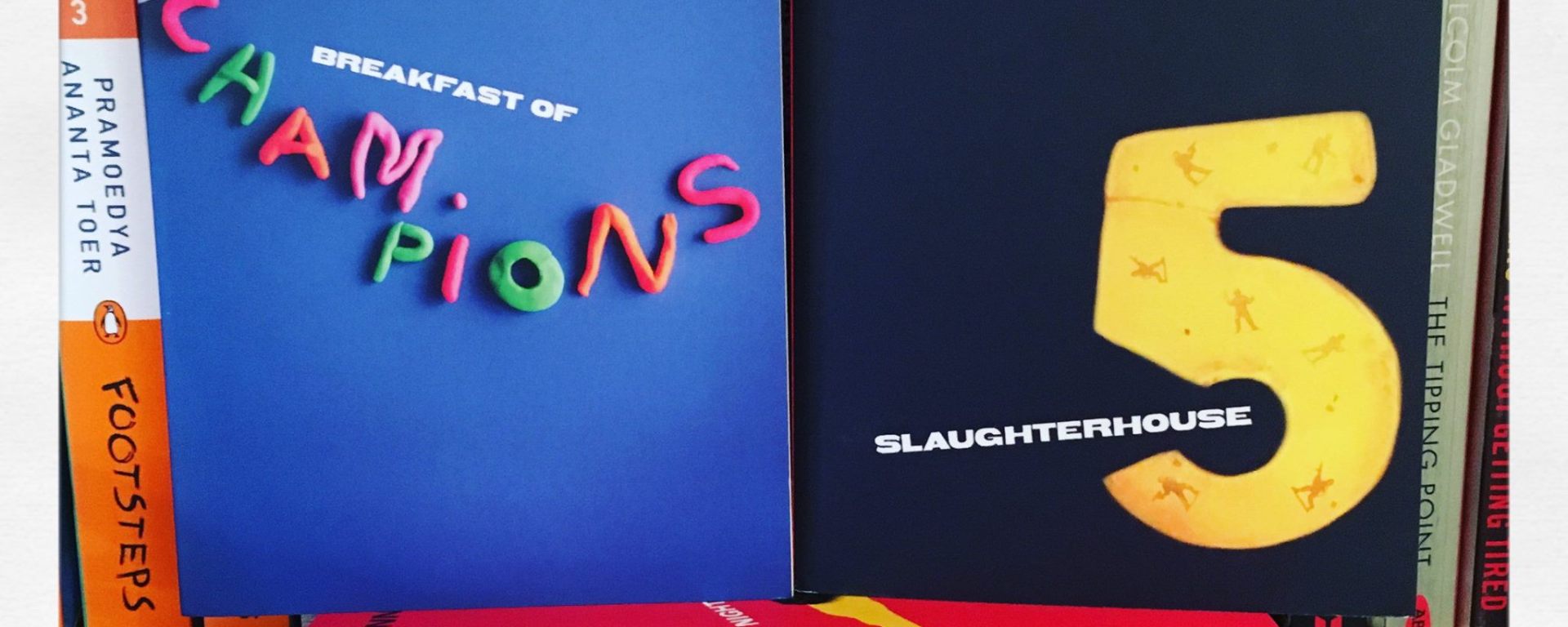
“Slaughterhouse 5” by Kurt Vonnegut (U.S.)
In February 2017, as one of the Author Specials that were a part of the Story Connector Literature Circle, we had a lively discussion on Kurt Vonnegut‘s quirky books, original ideas, and views on American society! Readers said that they would so love for him to be around now so they could hear him wax satirical about current affairs.
Synopsis
Billy Pilgrim – hapless barber’s assistant, successful optometrist, alien abductee, senile widower and soldier – has become unstuck in time. Hiding in the basement of a slaughterhouse in Dresden, with the city and its inhabitants burning above him, he finds himself a survivor of one of the most deadly and destructive battles of the Second World War. But when, exactly? How did he get here? And how does he get out?
Travel through time and space on the shoulders of Vonnegut himself. This is a book about war. Listen to what he has to say: it is of the utmost urgency.
Favourite Quote
I have told my sons that they are not under any circumstances to take part in massacres, and that the news of massacres of enemies is not to fill them with satisfaction or glee. I have also told them not to work for companies which make massacre machinery, and to express contempt for people who think we need machinery like that.

Story Connector Literature Circle (Oct 2016-Sep 2017)
Book Club Season 20
Self-Help Spring Season 2017
Summer Reading Group 2017
One-off discussions
PLUS
Author Specials
Chimamanda Ngozi Adichie – Nov 2016
Kurt Vonnegut – Feb 2017
* * * * * * *
From October 2016 to September 2017, Nicola tested out a new Story Connector Literature Circle. The idea behind this reading group came from her desire to take her two passions – world literature and personal development – and offer them in a combined package. Nicola was also fascinated by the many reasons WHY we read and wanted to explore them further with a group of like-minded readers.
The role of Story Connector in a Literature Circle is to try to find connections between the story and the outside world. This means connecting what we read with our own life, to what happens at work or in the community, to similar events at other times and places, or to other books we have read.
Nicola says author Ursula K. Le Guin sums up her reason for reading when she said: We read books to find out who we are. What other people, real or imaginary, do and think and feel is an essential guide to our understanding of what we ourselves are and may become.
 Nicola's Book Club