
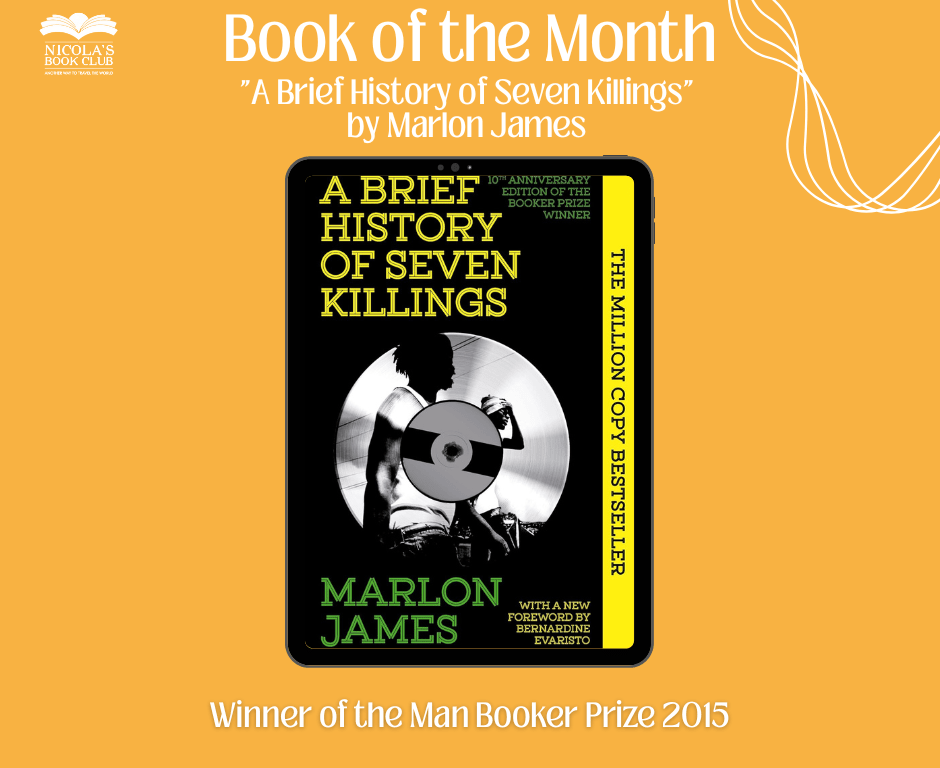
“A Brief History of Seven Killings” by Marlon James (Jamaica)
Winner of the Man Booker Prize 2015
Synopsis
On December 3, 1976, just before the Jamaican general election and two days before Bob Marley was to play the Smile Jamaica Concert to ease political tensions in Kingston, seven gunmen stormed the singer’s house, machine guns blazing. The attack wounded Marley, his wife, and his manager, and injured several others. Little was officially released about the gunmen, but much has been whispered, gossiped and sung about in the streets of West Kingston. Rumors abound regarding the assassins’ fates, and there are suspicions that the attack was politically motivated.
A Brief History of Seven Killings delves deep into that dangerous and unstable time in Jamaica’s history and beyond. James deftly chronicles the lives of a host of unforgettable characters – gunmen, drug dealers, one-night stands, CIA agents, even ghosts – over the course of thirty years as they roam the streets of 1970s Kingston, dominate the crack houses of 1980s New York, and ultimately reemerge into the radically altered Jamaica of the 1990s. Along the way, they learn that evil does indeed cast long shadows, that justice and retribution are inextricably linked, and that no one can truly escape his fate.
* * * * * * * * *
Review
“A Brief History of Seven Killings” is a brutal, ambitious, and stylistically daring novel that demands a lot from its readers—and often rewards that effort. Anchored by the assassination attempt on Bob Marley, the book weaves together real history and fiction to explore Jamaican political violence, gang warfare, and CIA involvement. The shifting, theatrical chorus of voices creates a fascinating, immersive portrait of a society shaped by power, fear, and manipulation, though the stream-of-consciousness narration and heavy use of Jamaican patois can make it a tough read. Many readers found themselves alternately locked in and completely lost, surrendering to the flow rather than fully grasping every storyline.
The violence—often raw, shocking, and at times nightmarish—along with depictions of sexual and sexualized violence, is deeply unsettling, but it rarely feels gratuitous. Instead, it paints a starkly realistic picture of a world where control is constantly exerted by unseen forces, both political and personal. Stylistically clever and structurally complex, the novel is a true marathon, but one some readers consider terribly important and compelling, especially now. Amid the testosterone-heavy narratives, the character of Nina Burgess stands out as a refreshing and engaging perspective, reinforcing the sense that this is not just a story of violence, but of voices struggling to be heard within it.
This second book of Season 26 scored 7.6 out of 10.
***Word of caution from Nicola***
I’ve been running my book club for more than twenty years, and despite the regular remarks I get for choosing challenging books, this was by far the toughest read we’ve ever taken on. The sheer level of violence, combined with the way the story is told, made it especially unsettling. It stayed with me in ways I didn’t expect, even giving me a few nightmares. I’d recommend this book only to readers who know they can handle something intense, and I’d think twice before giving it to impressionable teenagers or younger readers.
* * * * * * * * *
Nicola’s Book Club reading list
Season 26 – Book Award Winners (Nov 2025 – May 2026)
“Against The Loveless World” by Susan Abulhawa (Palestine) – Winner of the Palestine Book Award 2020
“A Brief History of Seven Killings” by Marlon James (Jamaica) – Winner of the Man Booker Prize 2015
“Lost Children Archive” by Valeria Luiselli (Mexico) – Winner of the Dublin Literary Award 2021
“The Garden of Evening Mists” by Tan Twan Eng (Malaysia) – Winner of the Man Asian Literary Prize 2012
 Nicola's Book Club