

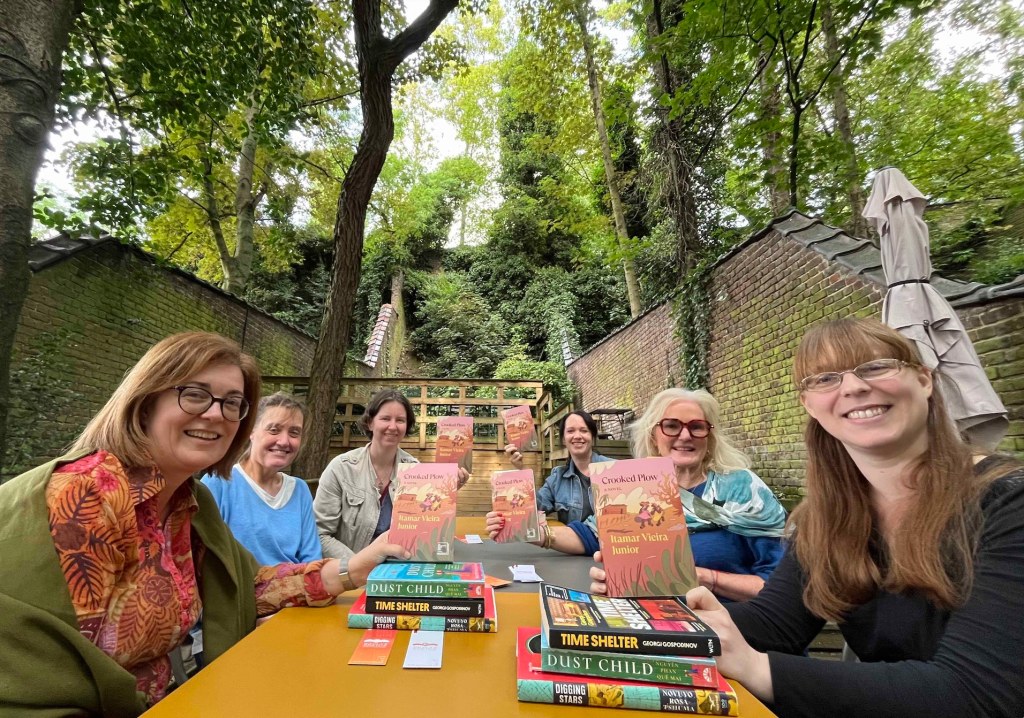
Readers found all four shortlisted books in this year’s Summer Reading Group enjoyable and easy to read. One reader even said that she had a difficult time choosing one as a favourite because they all made an impression on her. With their 2-word titles, some readers also noticed other dualities: in two of the books, the protagonists are 2 sisters; and in the other two books, the narrators grapple with loss (a physical one and a mental one). After a lively discussion on each of the books, “Crooked Plow” was voted Best Summer Read by a majority of readers.
“Crooked Plow” by Itamar Vieira Junior (Brazil) was chosen as Best Summer Read 2024. Set in the Bahia region of Eastern Brazil, this novel tells the story of two sisters and the childhood accident that shapes their lives. Readers appreciated its easy-to-read writing style and the use of magical realism. Many found it to be a sensitive and gripping story that provided insight into a different part of Brazil and its colonial past. They enjoyed the depth of the relationships and the exploration of different ways of life. While the book’s beginning, especially its gruesome start, was praised for being mesmerizing, some felt that the story lost a bit of its focus towards the end. Overall, the characters were well-received, and the book opened readers’ horizons.
“Dust Child”by Nguyen Phan Que Mai (Vietnam). Travelling between the 1960s and the 2010s, the novel has multiple narrators, including two sisters, who share their stories of the Vietnam War focusing on the search of Amerasian children for their American fathers. Most readers appreciated the story for its emotional impact, interesting characters, and the insight it offered into the war, particularly the children’s struggles. They found it an easy and engaging read, with historical details adding to the story’s appeal. However, others felt the writing lacked depth and was simplistic at times, with certain characters resembling those in a soap opera. While some praised its emotional resonance, a few felt it stayed too much on the surface, leaning heavily on facts rather than fully exploring the complexities of the subject matter.
“Time Shelter” by Georgi Gospodinov (Bulgaria). Set mainly in Zurich in the 20th century in a clinic treating patients with Alzheimer’s, an unnamed narrator is tasked with travelling the world to collect memorabilia from the past with which to decorate the clinic. Readers praised the intriguing concept and poetic, insightful start, with some finding its allegory of Europe looking back to the past particularly compelling. However, several found the book increasingly frustrating, noting its uneven flow and a jarring shift in tone. While some appreciated the exploration of Alzheimer’s, others found the focus on it distracting. Despite its cleverness and unique style, readers generally felt the execution faltered, requiring more effort to enjoy than anticipated.
“Digging Stars” by Novuyo Rosa Tshuma (Zimbabwe). From Zimbabwe to the US in the early 2000s, the daughter of a passionate astronomer attempts to follow in his footsteps after his untimely death. Some readers found the book interesting, whereas others felt it tried too hard to be clever with overly complex descriptions of galaxies that detracted from the story. The narrative seemed overloaded with ideas, making it feel like a debut novel to some. Although the story itself was appreciated, opinions about the characters were divided, with the narrator not resonating with everyone. Most felt that the book had a strong start, but the middle felt meandering and tangential, though readers did enjoy the ending.
 Nicola's Book Club